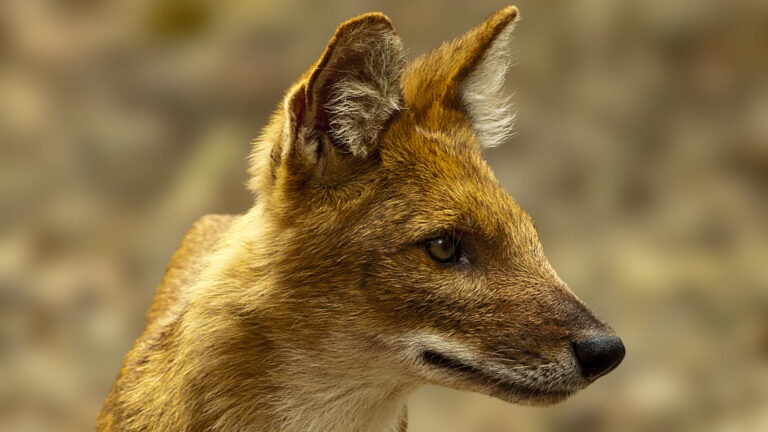
Dhole

The Dhole Working Group comprises 21 members working with the species across its distribution range. The group’s overarching goal is to promote dhole conservation by facilitating research, strengthening collaborative efforts, and disseminating scientific findings to both the research community and the public. In addition, the group aims to generate new knowledge about dhole biology, improve understanding of the threats they face, and identify effective mitigation strategies. Finally, the working group compiles and updates information on the species’ distribution, a foundation that is critical for population viability assessments and the development of evidence-based conservation action plans.
Past achievements of the working group include organizing the Population and Habitat Viability Assessment workshop and publishing the resulting report in 2019, as well as hosting the International Dhole Conference in Nepal. The latter effort stimulated interest among governmental and non-governmental organizations that in turn, contributed to the development of the national conservation action plan for the species.
Coordinator: Nucharin Songsasen
Facilitate the development of country specific action plans in Thailand and Nepal.
Understand the extent to which diseases impact dhole population viability.
Understand and identify mitigation strategies to address human-dhole conflicts.
Complete the Red List assessment.
Complete the Green Status assessment.
Projects conducted by working group members.
Human–dhole interactions in Bhutan:
The Last Northern Dholes project in the Qilian Mountains. The project uses camera trap survey and scientific monitoring to support dhole conservation — including the establishment of China’s first provincial nature reserve for the species. Watch the video
Engaging Communities in Dhole Conservation through Citizen Science in the Chitwan-Parsa Complex.
Transboundary effects on genetic structure and disease transmission risks in endangered dholes. This project integrates genomics, disease surveillance, and ecological data across multiple regions to understand how transboundary dynamics impact dhole populations.
1. The impact of health on dhole conservation through the development of sampling protocols and sharing of health information and expertise. https://wildlife.cornell.edu/people/martin-gilbert
2. The Wild Canids India Project - https://www.wildcanids.net A project examining the ecology, distribution and conservation of multiple canids & one hyenid found in India. The dhole is a focal species of interest.
3. Status and conservation of dholes in Parsa National Park, Nepal. https://wildlife.cornell.edu/people/martin-gilbert
4. Dhole ecology and conservation in Indonesia. Website: https://snm.ku.dk/english/staffsnm/research-and-collections/?pure=en/persons/394173
5. Movement ecology of dholes in Thai protected areas. https://movementoflife.si.edu/species/dhole/
6. Conservation priorities for dhole in Nepal and globally. The main objectives are to:
7. Evaluating community managed livestock insurance schemes and conflict prevention for dholes and large carnivores in eastern and central Nepal Himalayas.